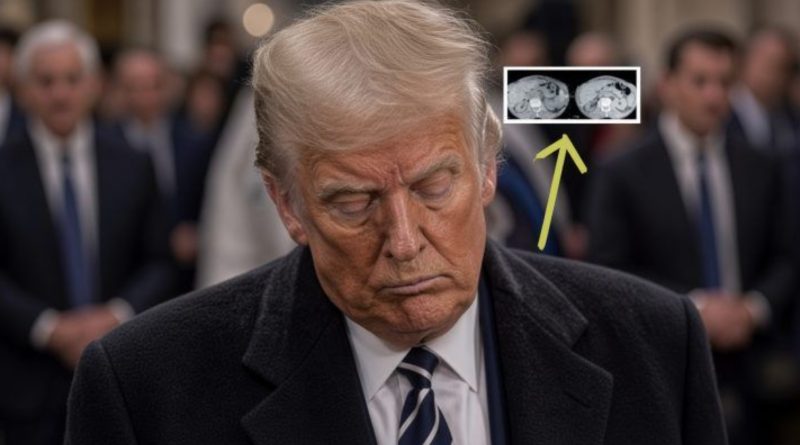
🚨 Trump’s MRI Results Spark Online Buzz — What Did the Scan Reveal? 👀
The scan was conducted at Walter Reed National Military Medical Center as part of an expanded medical evaluation described by the White House. Trump later addressed the examination while speaking with reporters aboard Air Force One, prompting questions about why the imaging had been performed, which parts of his body were examined and what his doctors had discovered. During the exchange, Trump repeatedly emphasized that the results were positive but acknowledged that he did not know precisely which area of his body had been scanned. At one point, he told reporters he had “no idea” what the MRI covered.
His remarks quickly attracted attention, with questions emerging about the purpose of the advanced imaging and whether it had been ordered as a precaution or in response to a specific medical concern. The White House subsequently offered additional information, describing the appointment as an expanded wellness evaluation intended to monitor the president’s health while he continued carrying out the responsibilities of the presidency. In early December 2025, White House physician Dr. Sean Barbabella released a memorandum explaining the general areas examined during the MRI.
According to the physician, the imaging focused on Trump’s cardiovascular system and abdomen. Barbabella reported that the results were “perfectly normal,” describing the findings as reassuring and indicating that the examination had identified no reported abnormalities in the areas assessed. The memorandum stated that the evaluation found no evidence of arterial narrowing, inflammation, clotting or abnormalities involving major organs. The physician presented the imaging as part of a preventive approach to monitoring the president’s health.
White House Maintains MRI Was Precautionary
The White House has maintained that the MRI was precautionary rather than prompted by a known serious medical problem. Officials have emphasized that physicians may use advanced imaging to obtain additional information about a patient’s condition, particularly when evaluating older adults. However, the administration has not released the raw MRI images or the complete underlying medical records associated with the examination. Public information has instead been provided through statements from Trump and summaries issued by his medical team.
That distinction has become central to the discussion, as the physician’s account offers a positive assessment without providing the public with the full medical documentation behind the findings. The episode has highlighted the continuing tension between a president’s right to medical privacy and the public’s interest in understanding the health of the country’s chief executive. Presidents routinely undergo medical examinations, and their physicians sometimes release summaries intended to reassure the public about their ability to perform the duties of office. However, the extent of those disclosures can vary, leaving reporters, medical observers and members of the public to debate whether the information provided is sufficient.
Critics of the administration’s initial response have argued that the lack of immediate detail surrounding the MRI created unnecessary uncertainty. They contend that clearer explanations about the purpose of the scan and the areas examined could have reduced speculation and prevented unsupported claims from spreading online. They also argue that providing more complete medical summaries, when appropriate, would help the public distinguish documented findings from rumors about a president’s condition. Trump and his supporters have rejected suggestions that the MRI indicates a serious health problem.
Presidential Health and Public Interest Debate
The president has repeatedly described his health in positive terms, pointing to medical assessments and his demanding schedule as evidence of his ability to continue performing his responsibilities. Nevertheless, the episode demonstrates how even limited comments about presidential medical testing can generate widespread interest, particularly when the initial explanation leaves important questions unanswered. Presidential health disclosures carry unusual significance because the office involves extensive executive responsibilities, national security decisions and the need for continuity in government. At the same time, medical privacy remains an important consideration.
Not every test necessarily indicates an illness, and advanced imaging can be used for several clinical purposes. The fact that an MRI was performed does not, by itself, establish that a patient has a serious medical condition. For that reason, medical assessments are best understood through documented findings and explanations from qualified physicians rather than speculation based on isolated remarks. In Trump’s case, the information made public by his physician describes the cardiovascular and abdominal imaging results as normal.
The available statements do not establish that the examination uncovered a serious medical problem. However, without the complete medical records, outside observers cannot independently evaluate every aspect of the scan or the broader clinical reasoning behind the decision to perform it. The MRI episode has become another example of the scrutiny that accompanies presidential health assessments. While the White House has sought to reassure the public through positive statements from the president and his physician, questions about the amount of information disclosed remain unresolved.
Balancing Privacy and Transparency
For now, the administration’s stated position is that the examination produced reassuring results and that Trump remains capable of fulfilling his presidential duties. The broader issue extends beyond one medical test. It concerns how administrations can communicate health information clearly, protect legitimate medical privacy and maintain public confidence without allowing incomplete information to fuel unfounded conclusions. Ultimately, the episode underscores the continuing challenge of balancing presidential medical privacy with the public’s interest in transparent, reliable information about the health of the nation’s highest elected official.