😱 People Were Outraged After Discovering What Went Wrong — Details Revealed… 👀
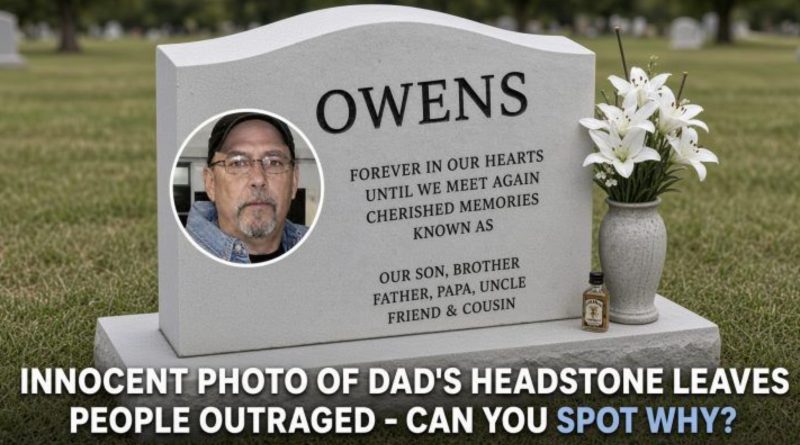
LOCAL DESK – A granite headstone commissioned as a lighthearted family memorial has ignited a sharp administrative dispute after cemetery operators discovered that relatives embedded an acrostic profanity into the permanent epitaph, exposing a rare legal and ethical conflict over the boundaries of free expression on sacred ground.
The controversy centers on a monument erected by the surviving children of a recently deceased patriarch, designed to commemorate both his memory and the irreverent sense of humor that defined his household. The dispute began when caretakers at the cemetery decoded the text, prompting the governing board of trustees to demand the removal or physical modification of the stone on the grounds that vulgar language violates the rules and regulations established to protect the decorum of the communal resting place.
The family has refused to alter the monument, arguing that the inscription represents a harmless inside joke and an authentic tribute. The resulting standoff has raised legal questions regarding private memorialization, consumer contracts, and property rights within shared memorial parks.
An Acrostic Concealed in Plain View
The centerpiece of the dispute is an acrostic-a literary device where the initial letter of each successive line or stanza spells out an underlying phrase when read vertically.
Read horizontally, the epitaph presents an ostensibly heartfelt, standard reflection on duty, family bonds, and life lessons. Vertically, however, the leading characters align to form a blunt, vulgar directive.
The family maintains that the hidden phrase was chosen deliberately to reflect a running inside joke shared between their late father and his children throughout his final months. Relatives have stated publicly that the phrase carries deep emotional resonance for those who knew him best, asserting that it was never designed to insult strangers or draw public notoriety. From their perspective, the monument serves as a deeply personal conduit for grief, capturing the authentic personality of the deceased rather than a generic or sanitized epitaph.
Cemetery administrators, however, contend that the private nature of the humor does not negate its physical presence in a communal environment.
Trustees argue that allowing an explicit profanity to remain carved in stone-even if veiled through clever phrasing-sets a disruptive precedent that compromises the tranquil atmosphere guaranteed to other grieving families visiting adjacent plots.
The impasse illustrates the delicate balance that exists between personal property and communal rules in modern deathcare operations:
Contractual Restraints: Most cemetery deed covenants explicitly reserve the right for operators to approve, alter, or reject monument designs that contain obscene, defamatory, or commercially inappropriate content.
The Shared Aesthetic: Trustees point out that memorial grounds are shared spaces where solemnity must be maintained across diverse cultural, religious, and personal standards.
Precedent and Parity: Regulators argue that overlooking a deliberately concealed vulgarity makes it nearly impossible to enforce standard inscription decency guidelines against future applicants.
Private Remembrance Versus Institutional Governance
Attorneys specializing in property and probate law note that the resolution will likely depend on the precise language of the original plot purchase agreement and the bylaws governing the monument company’s installation permit. While families frequently retain ownership of the physical granite marker itself, the cemetery corporation typically exercises broad legal discretion over what stays installed on the physical real estate.
The dispute has sparked a wider conversation about the changing cultural norms surrounding memorialization. As contemporary families increasingly move away from conventional, religiously centered funerals in favor of deeply personalized celebrations of life, unconventional inscriptions, QR codes linked to personal websites, and colloquial epitaphs have become common across modern memorial parks.
For deathcare professionals, the transition presents complex administrative challenges. When a grieving family’s personal expression directly clashes with institutional mandates, cemetery directors are often left to navigate emotionally volatile disputes without clear, objective boundaries separating whimsical personal history from actionable obscenity.
The Broader Boundaries of Grief and Decorum
If mediation efforts between the trustees and the family collapse, the dispute could move to municipal court for a contractual declaratory judgment. For now, the memorial remains in place as both parties weigh their legal options, leaving the granite inscription as an unresolved symbol of the modern friction between how families choose to remember the dead and the institutional rules governing the grounds where they rest.