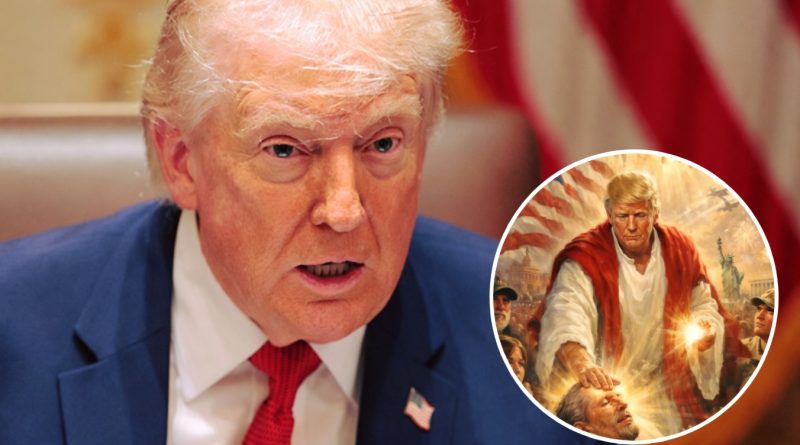
Trump Faces Criticism From Religious Conservatives After Sharing AI Image of Himself as “Jesus”
Donald Trump has recently become the focus of renewed online and political discussion after sharing an AI-generated image on his social media platform, Truth Social, sparking widespread debate.
The image quickly attracted attention due to its religious symbolism and stylized portrayal of Trump in a Christ-like role. The visual presentation prompted mixed reactions across political and religious communities, with interpretations ranging from symbolic messaging to concerns about appropriateness.
The controversy emerged shortly after Trump posted a separate message criticizing Pope Leo XIV. In that message, Trump used strong language, describing the pope as “weak” on crime and “terrible” on foreign policy decisions. Shortly afterward, Trump shared the AI-generated image without any explanation, which further fueled confusion and debate about its intended meaning.
The illustration depicted Trump wearing flowing white and red robes, standing over a hospital bed while placing his hand on an elderly man in what appeared to be a healing gesture. Observers quickly noted similarities to traditional religious depictions of Jesus Christ healing the sick, intensifying discussion about symbolism and interpretation.
In the same scene, background figures — including medical staff, soldiers, and civilians — appeared to observe the moment with reverence or emotion. Additional visual elements in the background resembled well-known American landmarks such as the Statue of Liberty and the Lincoln Memorial, along with an American flag.
Other reported details included stylized imagery such as eagles, military aircraft, and glowing atmospheric effects, contributing to a dramatic and symbolic tone. These elements reinforced the image’s highly stylized nature and opened the door to multiple interpretations.
Because the image was AI-generated, reactions varied widely. Some viewers interpreted it as satire or symbolic political commentary, while others viewed it as inappropriate or provocative. One point of discussion involved claims circulating on social media that the patient resembled a well-known public figure, though this interpretation has not been confirmed.
Online reactions spread rapidly across platforms. Critics described the image as problematic due to its religious undertones, arguing that it blurred boundaries between political identity and sacred symbolism. Some religious conservatives also expressed concern that the imagery crossed into religious appropriation or symbolic exaggeration.
Others were more direct, calling the image offensive or unsuitable for a public political figure — particularly given its timing alongside sensitive religious and international discussions. At the same time, supporters interpreted the post differently, suggesting it may have been intended as artistic or symbolic expression rather than a literal religious claim.
Even within conservative circles, reactions were mixed. While some defended the post as political expression, others — including voices from Christian media and religious commentary — expressed discomfort with the imagery’s tone and symbolism.
Several commentators argued that political leaders with large public influence should exercise caution when using religious imagery, noting that such symbolism carries deep cultural and emotional meaning. Others pointed out that AI-generated visuals are increasingly common and can easily be misinterpreted, especially when they involve emotionally charged themes.
Political analysts also noted that Trump has frequently used strong visual symbolism in his online communication. In the past, he has shared digitally created or stylized images portraying himself in exaggerated or symbolic roles, which similarly sparked public debate about political messaging and visual rhetoric.
In this instance, critics argued that the religious dimension intensified reactions compared to previous non-religious imagery. Supporters, however, viewed it as part of a broader communication style blending symbolism, humor, and political messaging in a visual digital environment.
The discussion also reflects a broader cultural divide in how political imagery is interpreted in the age of artificial intelligence. As AI-generated content becomes more common in political communication, questions about authenticity, symbolism, and ethical boundaries continue to grow.
The lack of an official explanation from Trump has contributed to ongoing speculation. Without clarification, interpretation has largely been left to the public, media commentators, and political analysts.
Religious commentators emphasized that faith-based imagery carries deep meaning for many audiences, suggesting public figures should approach such themes carefully. Others countered that artistic and symbolic expression — including AI-generated visuals — is becoming a standard part of modern political discourse.
The controversy has also reignited broader conversations about how social media platforms amplify controversial content and accelerate reaction cycles. As with many modern political debates, responses have been highly polarized, often shaped by political affiliation and personal belief systems.
Observers note that this pattern reflects a growing trend in which digital imagery becomes central to political communication and public perception. The incident also highlights how AI-generated visuals introduce new challenges in distinguishing symbolic intent from literal interpretation.
With no single consensus on intent or meaning, discussions continue across media outlets and online communities. While some view the image as controversial, others see it as part of an evolving landscape of visual political messaging.
What remains clear is that a single AI-generated image has generated widespread attention — illustrating how quickly digital content can become a focal point in political discourse. The debate also underscores ongoing tensions between political expression, religious sensitivity, and emerging technology.
As AI-generated imagery becomes more accessible, analysts suggest similar controversies may become increasingly common. In the end, the situation demonstrates how one image can spark wide-ranging interpretations — reflecting diverse political, religious, and cultural perspectives across today’s digital landscape.