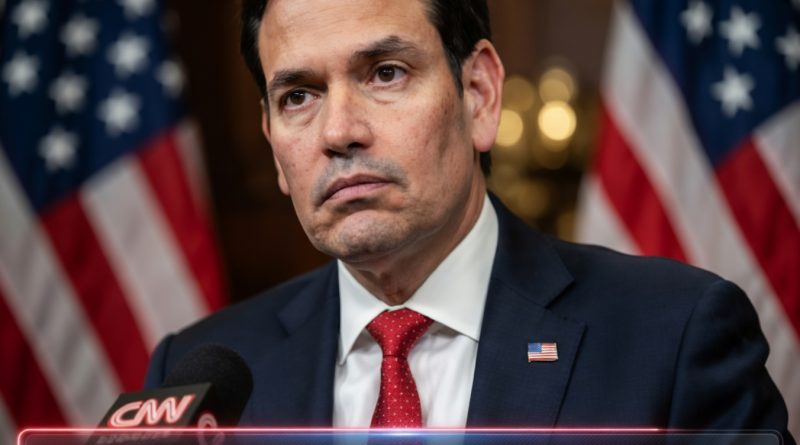
Rubio Revokes Brazilian Supreme Court Judge’s Visa For Bolsonaro Prosecution
Marco Rubio announced late Friday that the United States has revoked the visas of Alexandre de Moraes, several of his judicial allies, and their immediate family members. The move was described as a response to what Rubio characterized as a “political witch hunt” targeting former Brazilian President Jair Bolsonaro.
Rubio, who is also serving as national security adviser to Donald Trump, said the administration intends to hold foreign officials accountable for actions that, in its view, impact freedom of expression.
“President Trump made clear that his administration will hold accountable foreign nationals who are responsible for censorship of protected expression in the United States,” Rubio said in a statement.
Rubio went on to argue that Moraes’s actions against Bolsonaro had created what he described as a sweeping system of persecution and censorship. According to Rubio, the measures not only affected Brazilian citizens but also extended beyond Brazil’s borders.
“I have therefore ordered visa revocations for Moraes and his allies on the court, as well as their immediate family members effective immediately,” Rubio added.
The announcement came just hours after Brazil’s highest court issued restraining orders and search warrants against Bolsonaro. Authorities reportedly barred the former president from contacting foreign officials, placed him under electronic monitoring, and conducted a police raid at his residence.
In a ruling issued Friday, Justice Moraes also prohibited Bolsonaro from using social media. The decision cited concerns that Bolsonaro might attempt to leave the country, an allegation the former president has denied.
The legal actions stem from charges filed last year accusing Bolsonaro of attempting to overturn Brazil’s 2022 election results following his loss to current President Luiz Inácio Lula da Silva. Bolsonaro and several allies were indicted in February over what authorities described as an alleged coup attempt and efforts to remain in power.
Bolsonaro has denied wrongdoing and argued that the charges are politically motivated. He has also been barred from running for public office until 2030.
“I feel supreme humiliation,” Bolsonaro told Reuters in a recent interview. “I am 70 years old, I was president of the republic for four years.”
The diplomatic tensions escalated earlier in the week when Trump threatened to impose a 50 percent tariff on imports from Brazil, citing concerns about Bolsonaro’s prosecution.
Meanwhile, a separate diplomatic development unfolded involving Venezuela. Officials confirmed that Nicolás Maduro oversaw the release of 10 jailed U.S. citizens and permanent residents as part of a multi-country agreement involving the United States and Nayib Bukele.
The deal also secured the return of dozens of migrants previously deported by the United States to El Salvador under the Trump administration’s immigration crackdown. The three-nation arrangement was described as a diplomatic gain for Venezuela while advancing U.S. efforts to bring detained Americans home.
“Every wrongfully detained American in Venezuela is now free and back in our homeland,” Rubio said, thanking Bukele for his role in the negotiations.
Bukele confirmed that El Salvador transferred all Venezuelan nationals in its custody, while Maduro described the day as “a day of blessings and good news for Venezuela,” calling it “the perfect day for Venezuela.”
At the center of the agreement were more than 250 Venezuelan migrants who had been held in El Salvador’s high-security Terrorism Confinement Center (CECOT). The facility has drawn international attention for its size and strict security measures.
Earlier in March, El Salvador agreed to detain the migrants in exchange for a reported $6 million payment from the Trump administration. Many of those detained had been accused of links to the violent Tren de Aragua.
The arrangement sparked controversy after Trump invoked the Alien Enemies Act to accelerate deportations, triggering a high-profile legal challenge that ultimately reached the U.S. Supreme Court.