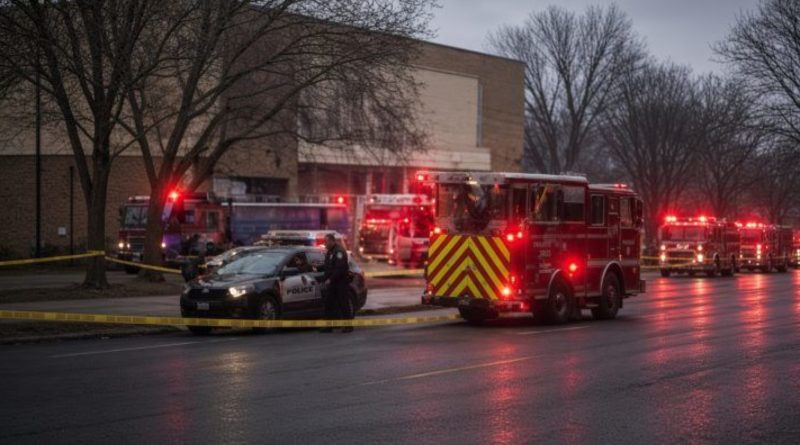
🛑 BREAKING 🛑 At least 5 dead, 5 injured after mass sh00ting at schoo… 💔😢🚨
A devastating multi-vehicle collision along one of Mexico’s most critical commercial transit arteries has claimed multiple lives, injured scores of motorists, and paralyzed transit for hours, thrusting long-standing national concerns over highway safety, freight regulation, and freight-corridor infrastructure back into sharp focus.
The disaster unfolded near the municipality of Huehuetoca at the notorious Jorobas junction, an intersection on Federal Highway 57 (the Mexico-Querétaro Highway) long known among commercial truckers and commuters for hazardous lane merges, dense fog pockets, and chronically heavy freight congestion. The chain-reaction pileup entangled private passenger vehicles and heavy tractor-trailers, scattering mangled metal and freight across multiple lanes and instantly turning a routine morning commute into an expansive disaster zone.
Federal Highway 57 represents the lifeblood of Mexican commerce, serving as the primary freight pipeline connecting Mexico City’s central distribution hubs to the Bajío industrial corridor and northern export trade routes leading toward the United States. Tens of thousands of freight rigs and commuter vehicles traverse the route daily. Because of its outsized economic role, any structural disruption instantly creates cascading logistical bottlenecks that ripple nationwide.
Collision sequence triggered rapid cascade
Witnesses reported that the collision sequence occurred within seconds, as high-speed traffic encountered sudden deceleration in an area plagued by reduced morning visibility. The initial impact triggered a rapid cascade of secondary collisions, with heavy freight carriers slamming into smaller passenger cars before jackknifing across the highway median. “The initial impacts sounded like continuous thunder,” said one stranded commercial driver who witnessed the crash from several hundred meters back. “By the time anyone could hit their brakes, the entire corridor was filled with smoke, burning rubber, and debris. There was nowhere for drivers behind them to steer.”
Emergency dispatch systems triggered a high-priority, multi-agency mutual aid deployment within minutes of the first 911 calls. Regional civil protection squads, municipal firefighters from surrounding districts, Red Cross paramedics, and units from the National Guard converged on the Jorobas sector. Upon arrival, first responders encountered a heavily compromised crash scene with multiple motorists pinned inside crushed vehicle passenger compartments.
Specialized urban search-and-rescue teams deployed hydraulic spreaders and cutters to extricate trapped occupants, working cautiously around leaking diesel fuel tanks and destabilized freight containers. Medical personnel established an on-site field triage center along the shoulder to categorize injuries and stabilize critical victims prior to transport. Ambulances established a continuous transit shuttle to regional trauma centers in Cuautitlán Izcalli and surrounding municipalities, while regional hospitals activated mass-casualty surge protocols to absorb the influx of trauma patients suffering from severe crush injuries, fractures, and shock.
Investigation underway into root causes
Federal highway police and the National Guard cordoned off kilometers of the northbound and southbound lanes, redirecting commercial traffic onto regional feeder roads that quickly clogged with heavy vehicles. Heavy-duty towing cranes and road-clearing machinery worked into the afternoon to extract the wreckage, sweep shattered glass and cargo, and clear hazardous fluid spills from the asphalt before lanes could be safely inspected.
Federal transport safety authorities and state prosecutors have opened a formal, comprehensive inquiry into the root causes of the pileup, collecting black-box telemetry, dashcam footage, and physical skid mark measurements across the crash envelope. Investigators are evaluating several compounding variables: Speed and Following Distance: Operating speeds on the downhill approach toward the Jorobas interchange frequently exceed posted limits, severely diminishing reaction windows when heavy vehicles encounter unexpected congestion. Mechanical Integrity and Maintenance: Mechanical inspectors are scrutinizing the braking assemblies, tire wear patterns, and weight manifests of the commercial trucks involved to determine whether brake fade or overloaded axles contributed to an inability to stop. Microclimatic Conditions: Early reports suggest localized morning fog or smoke in the valley reduced visibility down to a few dozen meters, concealing stopped traffic until impact was unavoidable.
Forensic collision reconstructionists emphasized that catastrophic pileups of this nature rarely stem from a single error. Instead, they typically represent a fatal convergence of systemic factors-mechanical wear, driver fatigue, environmental hazards, and highway design limitations intersecting simultaneously.
Renewed calls for highway safety reforms
The catastrophe has reignited fierce public debate over highway safety standards and freight transport oversight in Mexico. Freight transport associations, road safety advocacy groups, and bereaved families are once again pressing federal lawmakers to enforce stricter regulatory measures across Federal Highway 57. Primary among the demands is rigorous enforcement of maximum speed limits through automated speed-monitoring gantries, mandatory resting periods to curb driver exhaustion, and stricter weight verifications to remove dangerously overloaded rigs from high-speed corridors.
Industry critics have also demanded mandatory annual mechanical certifications for long-haul fleet operators, pointing to aging equipment as a recurring factor in high-fatality highway incidents. Furthermore, transportation engineers argue that the physical infrastructure of Federal Highway 57 must evolve to match surging freight volumes driven by nearshoring manufacturing booms. Proposed long-term solutions include dedicated heavy-freight bypass lanes, modernized overhead digital signage warning drivers of downstream slowdowns, and redesigned highway interchanges at chronic accident blackspots like Jorobas.
As roadway crews cleared the final remnants of crushed machinery and regular traffic cautiously resumed along the highway, the physical roadway returned to normal. Yet for the families coping with sudden loss and the survivors beginning grueling medical recoveries, the tragedy leaves an enduring mark-serving as a stark, urgent reminder that commercial efficiency on the nation’s highways cannot come at the expense of human life.