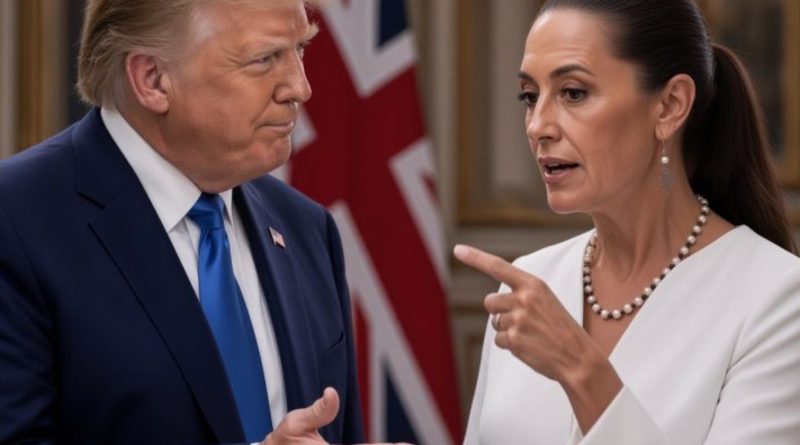
Mexico President’s Alleged Warning About Trump Sparks Political Debate
A statement attributed to Mexico’s president claiming that President Donald Trump is “not above the law” has drawn attention online, reigniting debate over presidential authority, constitutional limits and the relationship between the United States and Mexico.
The claim, featured in a widely circulated social-media graphic, presents the Mexican leader as delivering a blunt message about the limits of presidential power. However, the specific statement shown in the graphic could not be independently verified through reliable current reporting, making it important to distinguish the circulating claim from a confirmed official statement. The broader phrase at the center of the controversy has deep roots in U.S. constitutional debate.
The principle that no president is above the law has repeatedly been invoked in disputes involving executive power, presidential immunity and the authority of the courts. The issue has become particularly significant in discussions surrounding Trump. In a landmark 2024 decision involving presidential immunity, the U.S. Supreme Court stated that a president is not above the law, while also ruling that presidents have substantial immunity from criminal prosecution for official acts.
Constitutional Framework and Legal Debate
The court distinguished between official conduct and unofficial acts, creating an important legal framework for determining when presidential actions can be subject to criminal prosecution. That ruling continues to shape the broader debate over the scope of presidential authority. Supporters of Trump have argued that presidents require sufficient legal protection to carry out their constitutional responsibilities without facing politically motivated prosecution.
Critics have countered that excessive immunity could weaken accountability and the principle of equal application of the law. The issue also carries an international dimension because Mexico and the United States maintain one of the world’s most important bilateral relationships. Disputes between the two governments can quickly affect discussions involving trade, immigration, border security, drug trafficking and regional diplomacy.
Any direct criticism of a sitting U.S. president by Mexico’s government would therefore attract considerable attention, particularly if it involved the constitutional limits of presidential power. But without confirmation from Mexico’s government or reputable news organizations, the wording in the viral graphic should not be treated as an authenticated presidential statement.
Verification Concerns and Political Impact
For now, the central question is not simply whether the message reflects a broader political argument about Trump. It is whether the Mexican president actually made the statement attributed to her. The distinction matters.
In an increasingly fast-moving political environment, dramatic headlines and social-media graphics can spread before their underlying claims are independently confirmed. Previous legal debates in the United States have demonstrated that the phrase “not above the law” carries significant constitutional meaning, but its appearance in a viral image does not by itself establish that a foreign head of state made the statement. The controversy nevertheless highlights a larger question facing democracies: how should executive power be balanced against judicial oversight and the rule of law?
That debate is likely to remain central to American politics as questions surrounding presidential authority continue to generate intense partisan disagreement.