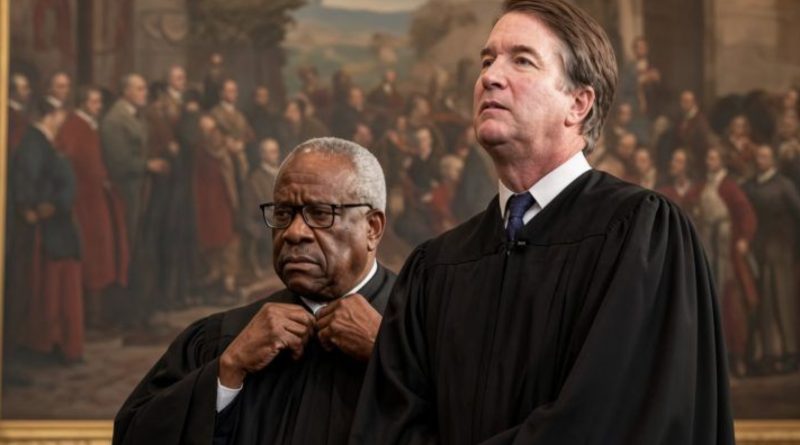
Justice Clarence Thomas Challenges Supreme Court’s Decision to Reject Florida Immigration Case
Justice Clarence Thomas sharply criticized the Supreme Court’s decision to decline Florida’s lawsuit against Washington and California, arguing that the state was entitled to have its claims heard by the nation’s highest court.
Thomas, joined by Justice Samuel Alito, questioned whether the court could properly refuse to exercise jurisdiction over a dispute between states when no lower federal court has authority to resolve such a case. His dissent focused on the constitutional role of the Supreme Court in handling conflicts between states. Florida’s lawsuit challenged commercial driver’s licensing policies in Washington and California. The state argued that the policies failed to comply with federal requirements governing commercial licenses, including standards involving English proficiency and immigration status.
In his opinion, Thomas emphasized the unusual constitutional position of disputes between states. Because the Supreme Court is the only federal court with original jurisdiction over such controversies, he argued that refusing to hear the case could leave a state without a judicial forum for resolving its claims. “If this Court does not exercise jurisdiction over a controversy between two States, then the complaining State has no judicial forum in which to seek relief,” Thomas wrote.
Constitutional Authority and Highway Safety Concerns
The case also involved concerns over highway safety following a fatal Florida crash involving truck driver Harjinder Singh. Florida cited the incident while arguing that failures to enforce federal commercial licensing requirements could create serious risks for motorists. Thomas contended that federal law establishes specific standards for commercial drivers and that states must comply with those requirements when issuing commercial licenses. He argued that the allegations raised by Florida were significant enough to warrant consideration by the Supreme Court rather than dismissal at the outset.
The justice also distinguished disputes between states from ordinary appeals, where the Supreme Court has substantial discretion over which cases it chooses to review. “We have no more right to decline the exercise of jurisdiction which is given, than to usurp that which is not given,” Thomas wrote.
Broader Debate Over Supreme Court Authority
The disagreement highlights a broader debate over the Supreme Court’s constitutional responsibilities and the limits of its discretion. While the majority declined to take up Florida’s challenge, Thomas and Alito argued that the case presented precisely the type of interstate dispute the Constitution places within the Supreme Court’s authority. The decision does not resolve the underlying allegations against California or Washington. Instead, it leaves Florida without the Supreme Court review it had sought and underscores a continuing disagreement among the justices over when the court should exercise its original jurisdiction.
For Thomas, the central issue was not simply the licensing policies at the heart of the dispute, but whether a state should be denied access to the only federal court constitutionally empowered to hear its claims against another state.