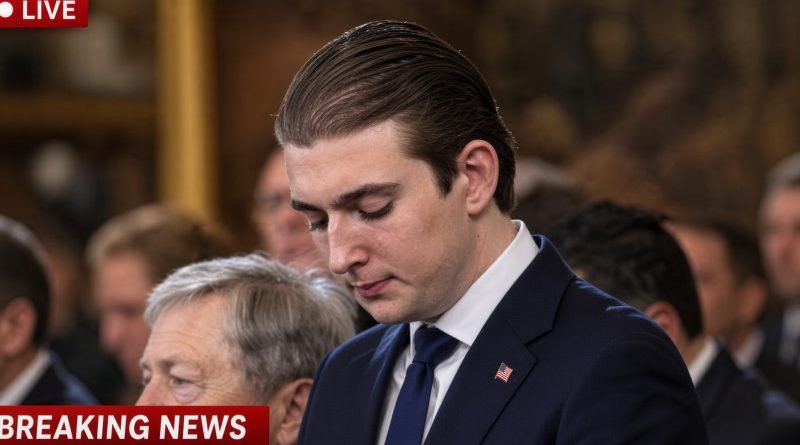
Escalating Iran Tensions Trigger Heightened Security for Barron Trump and First Family
Intensified, Iran-linked digital threats targeting Barron Trump have mobilized federal national security agencies, escalating protective operations for President Donald Trump’s youngest son amid dangerously elevated geopolitical tensions between Washington and Tehran. Intelligence-gathering and law enforcement bodies are on high alert following reports that state-adjacent platforms in Iran have circulated explicit propaganda menacing the 20-year-old. These disturbing materials, which include unverified and sensational claims of a $10 million bounty, signal a troubling departure from standard psychological warfare by explicitly targeting a non-political immediate family member. This reported shift represents a stark escalation in hostile rhetoric previously aimed primarily at the President and First Lady Melania Trump. Security analysts warn that while such campaigns are often designed to sow panic and discord, any specific, direct threat necessitates a robust, inter-agency operational response.
The United States Secret Service, responsible for the lifelong protection of the President and immediate family, has confirmed it is “aware of the circulating content.” Crucially, officials emphasize that all potential threats against protectees, regardless of their origin or perceived credibility, undergo rigorous and continuous evaluation. Protective Footprint: The Secret Service maintains comprehensive, round-the-clock physical security details for both Barron Trump and First Lady Melania Trump, adapting postures to counter evolving threat vectors. Facility Hardening: Advanced defensive protocols and site perimeter expansions are in effect at all primary family properties. Secured locations include the White House, Mar-a-Lago in Florida, Trump Tower in New York, and the family’s Bedminster estate in New Jersey.
Investigative Response and Security Measures
Investigative Focus: Citing paramount operational security, official agencies have declined to disclose specific tactical adjustments, physical enhancements, or active investigative steps. However, counter-intelligence and digital forensics units are deeply engaged in tracing the origin and dissemination networks of the threatening materials. This escalating digital hostility unfolds during one of the most volatile periods in U.S.-Iran relations. President Trump has repeatedly issued severe warnings against Iranian aggression, while state-aligned media in Tehran have matched the rhetoric, threatening retaliation for perceived grievances.
Security experts emphasize that differentiating between general, state-sanctioned posturing and actionable, imminent attack capability is now a primary intelligence objective. The propaganda is not viewed as a simple disinformation campaign; it is treated as a component of a hostile state’s broader asymmetric strategy, where the ultimate objective may be intimidation rather than kinetic execution, but where any failure of protection is an unacceptable strategic loss.
Unique Security Challenge for Barron Trump
For Barron Trump, who has consistently prioritized a private life and meticulously stayed clear of political campaigns and official government functions, the persistent, state-linked media targeting presents a unique and distinct security challenge. Unlike political figures who may choose their level of public exposure, he is being thrust into the center of an international crisis solely by virtue of his relationship to the President. Federal authorities maintain that protective measures remain comprehensive, highly adaptable, and, by necessity, confidential.
They urge the public and media to treat sensational, unverified online claims with extreme caution as official investigations into state-sponsored threats against American protectees proceed. The heightened surveillance over state-linked communication channels is expected to persist as long as the fundamental diplomatic and military friction between the two nations remains unresolved.