🚨 BREAKING: Trump’s Walter Reed Scan Faces New Scrutiny as Physician Releases Report…
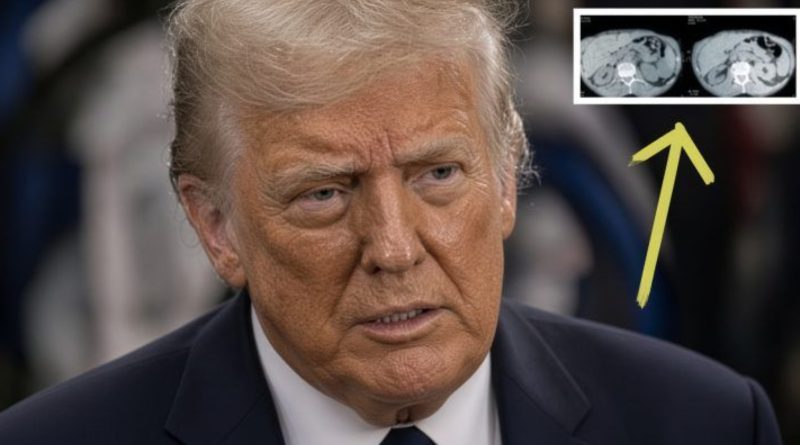
WASHINGTON – President Donald Trump’s October 2025 medical examination at Walter Reed National Military Medical Center drew public attention after he discussed undergoing advanced imaging but initially offered few details about the procedure. The episode prompted questions about the purpose of the scan, the information released by the White House and the level of medical transparency expected of a sitting president. Trump described the results as “perfect” when speaking with reporters aboard Air Force One in November. However, when asked which part of his body had been examined, he said he had “no idea,” adding that the procedure had not involved his brain. The White House subsequently released a medical memorandum outlining the examination. President Trump’s physician, Navy Capt. Sean Barbabella, said the imaging focused on the president’s cardiovascular system and abdominal area and reported that the results were normal. The episode later took another turn when Trump clarified in January 2026 that the procedure had been a CT scan rather than an MRI, correcting the terminology he had previously used.
Trump underwent the examination at Walter Reed on October 10, 2025, approximately six months after his previous publicly reported physical in April. The White House initially described the visit as a scheduled follow-up evaluation that included laboratory testing, advanced imaging and preventive health assessments. The October 10 physician’s memorandum said the examination was intended to support the president’s ongoing health maintenance and included assessments conducted with a multidisciplinary team of medical specialists. The additional visit attracted attention because the administration had not initially provided detailed information about the imaging procedure. Questions from reporters followed, particularly after Trump publicly discussed the scan without identifying the body areas examined. The uncertainty did not establish that the president had an undisclosed medical condition. It did, however, create questions about why the advanced imaging had been performed and what information the administration was prepared to release.
On December 1, 2025, the White House released a memorandum from Barbabella explaining the purpose and reported findings of the imaging. According to the physician, the examination included imaging of Trump’s cardiovascular system and abdomen. Barbabella described the testing as preventive, saying it was intended to identify potential issues early and provide a more detailed assessment of the president’s health. The memorandum stated that the cardiovascular imaging showed no evidence of arterial narrowing that impaired blood flow and no identified abnormalities involving the heart or major blood vessels. It also reported that the heart chambers were normal in size and that the assessment showed no signs of inflammation or clotting. The abdominal imaging was likewise described as normal. Barbabella said the major organs examined appeared healthy and that the evaluated systems were functioning within normal limits, with no acute or chronic concerns identified in the reported findings. The physician concluded that Trump remained in excellent overall health. These statements represented the administration’s published medical assessment; the White House did not release the underlying imaging files for independent public review.
Medical Clarifications and Ongoing Debate
An important clarification emerged in January 2026, when Trump told The Wall Street Journal that the October procedure had been a CT scan, not an MRI. Barbabella subsequently confirmed the distinction in a statement to CBS News. The physician said medical advisers had recommended advanced imaging, allowing for either an MRI or a CT scan, to evaluate the president’s cardiovascular health. According to the statement, the medical team ultimately performed a CT scan and reported no abnormalities in the results. The difference matters because CT scans and MRIs use different technologies. A CT scan combines X-ray images to produce detailed pictures of internal structures, while an MRI uses magnetic fields and radio waves. Both procedures can provide valuable medical information, but they are not interchangeable terms. The later clarification resolved the discrepancy between Trump’s earlier description and the physician’s account of the test that was actually performed.
Trump also said in January that, in retrospect, he regretted undergoing the scan because it had fueled speculation about his health. He maintained that the examination had not revealed a problem. The episode renewed a longstanding debate over how much medical information presidents should disclose. The public has a strong interest in understanding whether a president can perform the responsibilities of the office, while individuals-including public officials-retain legitimate interests in medical privacy. Presidential medical disclosures have varied considerably over the years. Some administrations have released detailed summaries, while others have provided more limited updates. Physicians and outside medical experts may also disagree about which tests are appropriate in particular circumstances, especially when the underlying clinical records are unavailable.
In Trump’s case, the administration characterized the October imaging as preventive and reported normal findings. The limited public documentation, however, means outside observers cannot independently examine the images or assess the full clinical reasoning behind the procedure. That limitation should not be interpreted as proof of an undisclosed illness. Equally, an official summary should be distinguished from a complete public release of a patient’s medical records. The documented timeline establishes that Trump underwent advanced imaging during his October 10, 2025, examination at Walter Reed. His physician later reported normal cardiovascular and abdominal findings, and the president clarified in January 2026 that the procedure was a CT scan rather than an MRI. The administration’s published assessment described the results positively, but the underlying imaging files were not made public.
Understanding Presidential Health Transparency
Ultimately, the episode highlighted two separate issues: the medical findings reported by the president’s physician and the public’s interest in transparency about presidential health. The available information supports the conclusion that the White House reported normal findings from the examination. It does not provide a basis for speculation about an undisclosed diagnosis. As with other presidential medical updates, the distinction between an official assessment and independently reviewable medical evidence remains central to understanding what the public knows-and what remains private.