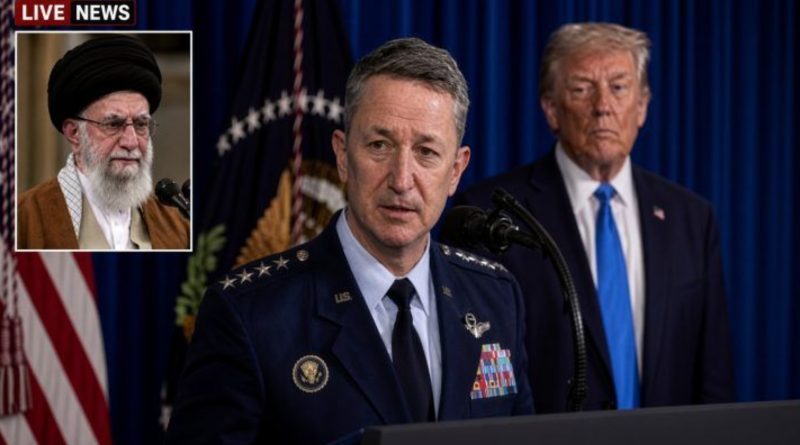
🚨 BREAKING: Trump Reportedly Rushes to Situation Room as Iran Tensions Escalate — Details Emerging…
A sharp, multi-theater escalation between the United States and Iran erupted in late July after the Islamic Revolutionary Guard Corps launched a volley of ballistic missiles targeting American military installations in the Middle East, setting off a swift series of coordinated retaliatory strikes across Iraq and directly into Iranian territory.
U.S. Central Command confirmed that the medium-range ballistic missiles were fired directly from Iranian soil on July 28 in what defense officials characterized as an attempted surprise saturation strike against American forward operating bases. Integrated air-defense batteries, including Patriot and THAAD interceptors, engaged and neutralized the incoming projectiles, preventing operational casualties and leaving regional U.S. forces positioned on maximum alert.
The ballistic confrontation catalyzed an immediate, multi-pronged counteroffensive involving American and Saudi combat aviation, marking an aggressive expansion of an armed conflict increasingly threatening critical energy arteries and regional infrastructure.
Coalition Sorties Strike Iranian Proxy Network in Iraq
Hours after the missile launches, American and Royal Saudi Air Force fighter squadrons launched a coordinated wave of precision airstrikes against logistics nodes, munitions depots, and command hubs operated by Iran-backed paramilitary formations in eastern Iraq.
According to CENTCOM communiqués, the targeted installations belonged to militia elements operating under the direct operational direction of the IRGC’s Quds Force. The coalition sorties were launched following an intensive 72-hour operational window during which Iran-aligned groups launched more than 30 one-way attack drones toward coalition positions and Saudi energy facilities.
The joint missions highlighted a deepening tactical alignment between Washington and Riyadh. Saudi authorities have grown increasingly alarmed over drone and cruise missile vectors threatening eastern oil installations, which serve as foundational pillars of international crude markets.
Iran-Aligned Militias Launch Sustained Attacks
In its strategic rationale, CENTCOM reported that Iran-aligned militias in Iraq had attempted more than 600 separate attacks against American personnel, diplomatic posts, and logistical convoys between February and April 2026. While independent verification of that aggregate remains limited by operational secrecy, the metric underscores the unrelenting pressure confronting forward-deployed forces.
The escalatory spiral deepened significantly on July 29, when CENTCOM announced that U.S. naval and air assets had crossed an operational threshold by executing a extensive wave of kinetic strikes against dozens of high-value IRGC targets located deep inside sovereign Iranian territory.
According to military statements, the strikes targeted: Integrated air-defense batteries and long-range early-warning radar arrays. Hardened underground ballistic-missile storage bunkers and drone assembly hangars. Coastal surveillance posts, anti-ship cruise missile sites, and naval command nodes along the Persian Gulf littoral.
Deep Strikes Penetrate Sovereign Iranian Territory
CENTCOM stated that the direct strikes were engineered to degrade Tehran’s capacity to threaten regional coalition personnel, commercial maritime traffic, and Gulf cooperation partners. The sequence marked an unmistakable transition from proxy-level border skirmishes to direct state-on-state kinetic warfare, bypassing previous diplomatic guardrails.
The confrontation is unfolding across an interconnected web of operational fronts stretching from the Mesopotamian basin through the Yemeni highlands to the maritime chokepoints of the southern Red Sea and the Strait of Hormuz.
The Strait of Hormuz remains the conflict’s most fragile pivot. Handling approximately 20 percent of global petroleum transit, any sustained interdiction or naval skirmish in the passage immediately reverberates across international shipping insurance markets, global energy exchanges, and supply networks.
Regional Theaters Converge on Vital Sea Lanes
Compounding the operational friction, Iran-aligned Houthi forces in Yemen have coordinated anti-ship missile volleys and long-range drone launches against Gulf shipping, forcing coalition navies to distribute air-defense magazines across thousands of miles of open water. The multi-front coordination has rendered individual border incidents inseparable from the broader theater war.
For Washington, the late-July exchanges demonstrated the complex challenge of deterring both direct ballistic strikes from sovereign Iranian launch sites and asymmetric pressure applied by allied proxy networks in adjacent states.
For Tehran, the widening scope of U.S. precision bombardment against domestic IRGC installations exerts intense pressure on its core defense architecture, testing its domestic air defenses and threatening its network of regional deterrent assets.
With each kinetic exchange triggering wider retaliatory operational packages, military analysts warn that the boundary between calibrated deterrence and unconstrained regional war has thinned dramatically. The focus across regional command centers remains anchored on hardening critical infrastructure and defending commercial maritime lanes against an escalatory cycle that continues to defy diplomatic containment.