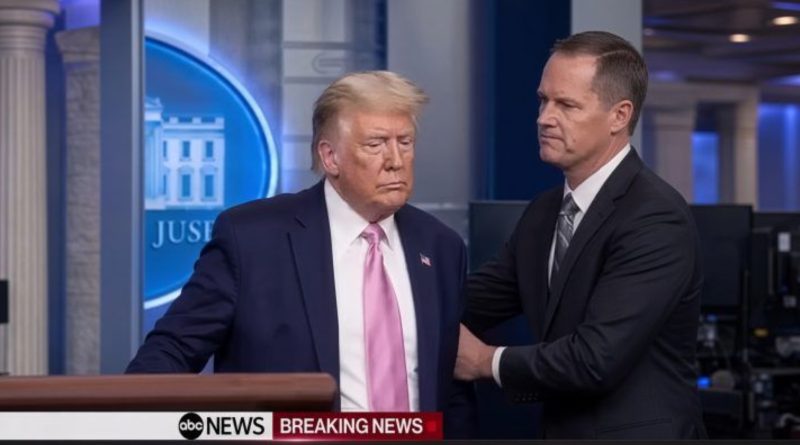
🚨 ABC News Interrupts Live Broadcast With Major Trump Update: “We’ve Just Been Informed…” 👀📺
WASHINGTON – An aggressive deployment of federal law enforcement assets across the District of Columbia has intensified a high-stakes national debate over municipal sovereignty, public safety, and civil liberties, exposing the unique constitutional fault lines governing the nation’s capital. Directed by President Donald Trump, the initiative has mobilized an array of federal entities-including components of the Department of Justice, the Department of Homeland Security, and specialized tactical units-to assume a visible, forward-operating role alongside the Metropolitan Police Department (MPD). The White House has framed the coordinated surge as an imperative to curb violent crime, disrupt narcotics distribution hubs, and re-establish public order across federal corridors and residential neighborhoods alike. The expanded federal footprint has sparked sharply divergent reactions across District communities, dividing residents between those who welcome the enhanced security presence and critics who view the operation as an alarming intrusion on local autonomy.
In several commercial corridors and public transit nodes, business associations and neighborhood advisory commissions have praised the intensified tactical visibility. Proponents argue that sustained elevated rates of armed carjackings, robberies, and street-level disturbances necessitated a decisive federal intervention to restore commercial stability. Supporters point to a noticeable deterrent effect, citing heightened foot patrols, vehicle checkpoints, and the disruption of open-air illicit markets as proof that increased enforcement produces immediate security dividends. From their vantage point, the multi-agency operation provides vital operational relief to an understaffed municipal police force that has struggled with attrition and prolonged emergency response times.
Conversely, civil liberties attorneys, community advocates, and public defenders argue that the surge has established an intimidating presence that disproportionately impacts marginalized and immigrant neighborhoods. Advocacy groups warn that embedding federal law enforcement apparatuses into routine neighborhood policing creates a pervasive chilling effect, discouraging undocumented residents from reporting offenses, accessing essential municipal health services, or stepping forward as prosecution witnesses. Residents in heavily saturated areas have also expressed confusion over command authority, noting the difficulty of distinguishing between local MPD officers subject to city oversight and federal personnel operating under separate operational directives and use-of-force protocols.
Constitutional Framework and Home Rule Debate
The federal intervention has revived deep-seated grievances surrounding the District’s anomalous legal framework. Unlike the 50 states, where the Tenth Amendment reserves broad, inherent police powers to state governments, Washington operates under the plenary authority of Congress pursuant to Article I, Section 8, Clause 17 of the U.S. Constitution. While the District of Columbia Home Rule Act of 1973 delegated municipal governance to an elected mayor and a 13-member council, local authority remains legally vulnerable to executive and legislative intervention. Under federal statutes, the president possesses specific emergency powers to federalize local police operations during acute civil emergencies, while Congress retains final legislative review over municipal statutes and city appropriations.
Municipal leaders and home rule advocates argue that bypassing local elected officials to mount an executive-led policing campaign fundamentally disenfranchises the District’s roughly 700,000 tax-paying residents. Constitutional scholars observe that the current deployment tests the structural boundaries of the Home Rule Act, injecting renewed momentum into legislative pushes by congressional Democrats to pass D.C. statehood and establish full sovereignty over local public safety.
Accountability and Operational Standards
A central operational concern raised by oversight boards centers on institutional transparency. While municipal police officers are bound by local civilian complaint review boards, local Freedom of Information Act mandates, and city council investigative hearings, federal agencies adhere to distinct administrative procedures that offer narrow channels for direct municipal accountability. Legal analysts emphasize several critical disparities that emerge when federal forces conduct urban patrol duties: Use-of-Force Standards: Federal tactical teams frequently follow operational standards tailored to high-risk perimeter protection or fugitive apprehensions rather than standard municipal de-escalation models. Evidentiary Video Access: Mandatory local disclosure rules governing MPD body-worn camera footage contrast sharply with federal agency guidelines, which severely restrict the public release of video evidence following critical incidents. Judicial Redress: Pursuing constitutional tort claims against federal personnel faces formidable procedural hurdles under qualified immunity doctrines and restrictive federal statutory frameworks compared to standard civil actions against local officers.
As interagency checkpoints and patrols continue across the capital, legal scholars, local officials, and civil rights litigators are closely monitoring the operation’s judicial and political fallout. The confrontation represents far more than an operational response to urban crime rates; it serves as a critical test of how the federal government exercises authority over the territory it shares with a self-governing populace.