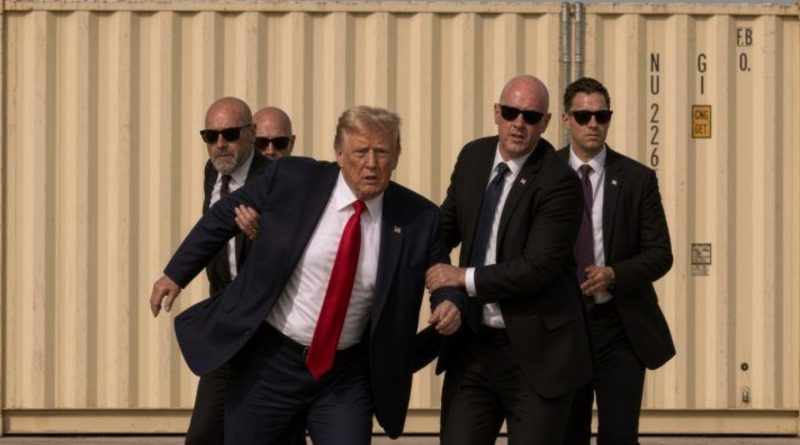
‼️ 20 minutes ago 🚨 Chaos as the President of the United States was… 🇺🇸😱👀
A wave of alarm reverberated across digital platforms following the rapid circulation of unverified assertions that former President Donald Trump had been targeted in a fresh shooting incident in the nation’s capital. The sensational claims, which surfaced during peak digital traffic hours, ignited immediate confusion, speculative commentary, and widespread public concern before systematic verification confirmed that no such security breach occurred. Within hours of the rumor’s initial propagation, law enforcement agencies, federal protection details, and emergency services confirmed that there was no record of an active incident involving the former president in Washington, D.C., or any other jurisdiction. The United States Secret Service, local municipal police departments, and regional trauma centers issued no alerts, emergency mobilizations, or incident reports-a standard operational baseline that immediately undermined the credibility of the viral claims.
A forensic analysis of the claim’s trajectory indicates that the false alert originated through fragmented, high-engagement social media posts rather than accredited journalistic reporting. The speculation appears to have gained traction through an amalgamation of recontextualized archival footage, deceptive thumbnails, and hyperbolic phrasing designed to circumvent algorithmic moderation and maximize engagement. Several widely shared posts featured spliced imagery originating from prior security incidents, paired with urgent, all-caps text suggesting an ongoing standoff in the capital. Rather than citing primary sources, institutional statements, or visual corroboration from verified eyewitnesses, the posts relied on generic attribution phrases such as “breaking reports confirm” and “unfolding situation right now.”
Independent fact-checking operations and mainstream newsrooms-which deploy permanent security beats across the White House, Capitol Hill, and campaign movements-monitored federal communications bands and quickly established that normal motorcade movements and public activities remained entirely uninterrupted. Security analysts emphasize that while legitimate breaking news events involving high-profile protectees trigger instant, coordinated emergency response maneuvers-including closed airspace, perimeter street shutdowns, and public briefings within minutes-no such tactical footprint was observed in the district.
History of Real Threats Against Trump
The heightened sensitivity surrounding Trump’s personal safety stems directly from documented historical precedent. In July 2024, an assassination attempt at a campaign rally in Butler, Pennsylvania, resulted in the former president sustaining an ear injury, the death of an attendee, and the fatal engagement of the gunman by Secret Service counter-snipers. That breach, followed by a subsequent thwarted plot at Trump International Golf Club in West Palm Beach, Florida, led to significant congressional oversight hearings, extensive operational shakeups within federal protective services, and permanent expansions in protective perimeters.
Because genuine physical threats against political figures remain an acute operational concern, false alarms exploit a psychological vulnerability in the public information space. Observers note that when audiences have already witnessed real, historically unprecedented security failures, the threshold of skepticism required to dismiss fictionalized claims is markedly lowered. Misinformation campaigns of this magnitude carry real-world consequences that extend far beyond online commentary boards.
Public safety experts point out that coordinated rumor mills impose immediate strain on emergency infrastructure. Dispatch switchboards, local law enforcement public information offices, and hospital switchboards routinely face an influx of inquiries from concerned citizens, diverting administrative focus from active, local emergencies. Furthermore, deceptive broadcasts accelerate the erosion of public trust in verified communications.
Dangers of Misinformation
Political scientists caution that in an increasingly polarized civic environment, uncorrected rumors can rapidly morph into broader conspiratorial narratives, with partisan factions projecting blame, manufacturing motives, and escalating tensions based entirely on fictitious premises. “Digital platforms currently operate under engagement incentives that reward emotional velocity over factual accuracy,” explained a senior fellow in media ethics and digital forensics. “When a sensational headline is introduced into an already volatile news cycle, the window between initial dissemination and widespread public panic is measured in seconds, whereas responsible investigative verification requires structured protocols.”
The proliferation of automated accounts, monetization schemes driven by outrage metrics, and sophisticated video recycling tools has transformed social networks into hostile information environments during developing stories. Media watchdogs urge consumers to apply stringent verification protocols before sharing claims characterized as national emergencies.
How to Verify Claims
Corroboration Across Primary Channels: Major domestic and international news agencies maintain rapid-response teams dedicated to protective details; silence across reputable news wires during an alleged national crisis is a definitive indicator of an unfounded claim. Identification of Official Declarations: Protective incidents invariably trigger prompt, public confirmations from authorized spokespersons, including the United States Secret Service, local law enforcement commands, and hospital administrations. Scrutiny of Visual Provenance: Utilizing reverse-image search mechanisms and cross-referencing archival media often reveals that sensational video clips are recycled materials from earlier, unrelated historical events.
As federal and local authorities reiterated throughout the day, normal security protocols remain active, and no new kinetic incident has targeted the former president. The rapid dissipation of the rumor serves as a clear illustration of modern digital dynamics: while false claims can capture millions of impressions within a matter of minutes, disciplined reporting and objective institutional verification remain the only durable defense against artificial panic.