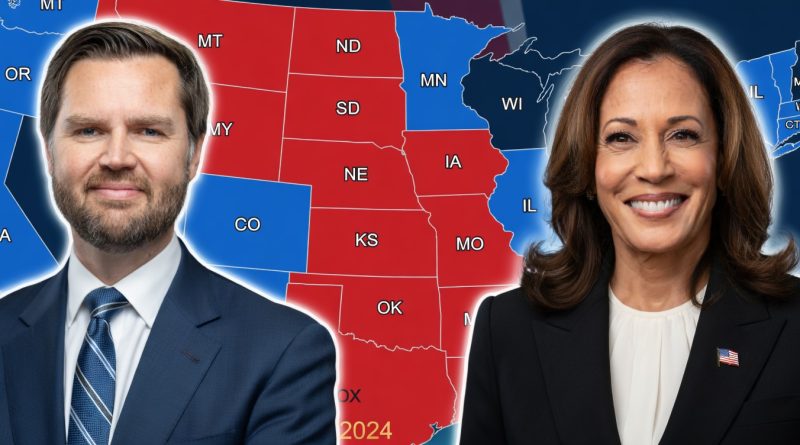
AI Model Makes Stunning Prediction of 2028 Presidential Winner
An artificial intelligence model has generated a speculative forecast for the 2028 U.S. presidential election—despite official candidates not yet being declared—drawing significant attention across social media and YouTube.
The projection was created using Grok, an AI chatbot associated with Elon Musk. A YouTube channel prompted the system to simulate a possible election outcome using hypothetical candidates. The resulting analysis included a state-by-state breakdown, an electoral map, and projected vote totals for figures from both major political parties.
As the host explained in the video, the exercise was designed to explore what a potential 2028 race might look like based on current polling trends and political momentum.
In the simulation, JD Vance was projected to win with 312 electoral votes, compared to 212 for Kamala Harris. As in all U.S. presidential elections, 270 electoral votes are required to secure victory.
On the Democratic side, Harris leads early primary polling with 32 percent support. She is followed by Gavin Newsom at 23.8 percent. Former Transportation Secretary Pete Buttigieg holds third place with just under 10 percent, while Alexandria Ocasio‑Cortez and Josh Shapiro trail closely behind.
The video notes that Harris’s renewed strength may surprise some observers, particularly after many commentators considered her political prospects uncertain following the 2024 election. Recent polling suggests her position has improved, and betting markets now estimate a 56 percent chance she will pursue the Democratic nomination in 2028—up significantly from 11.2 percent just months earlier.
On the Republican side, Vance leads early polling with 49.2 percent support. Donald Trump Jr. trails by 29 points, while Marco Rubio stands at 12.5 percent and Ron DeSantis at 9.2 percent. The simulation suggests Vance holds a 46 percent chance of securing the Republican nomination, with Rubio following at 18 percent.
The model categorized “solid” states as those with margins of 15 points or more. Vance’s projected solid states included much of the Mountain West, Great Plains, and parts of the South and Midwest, such as Utah, Idaho, Montana, Wyoming, the Dakotas, Kansas, Oklahoma, Missouri, Arkansas, Louisiana, Mississippi, Alabama, Tennessee, Kentucky, West Virginia, Indiana, South Carolina, and Ohio.
The inclusion of Ohio reflects a notable political shift. Once considered a critical swing state, the simulation suggests it could now lean firmly Republican, particularly following strong Republican performance there in recent elections.
Meanwhile, Harris’s projected solid states largely mirror traditional Democratic strongholds, including Washington, California, Hawaii, Vermont, Massachusetts, Connecticut, Delaware, Maryland, the District of Columbia, and Maine’s 1st Congressional District. The model also suggested Connecticut and Delaware could return to stronger Democratic margins after tighter races in previous cycles.
After tallying solid states, Vance held 139 electoral votes compared to Harris’s 108. The “likely” category—states with margins between 5 and 15 points—further expanded his lead. Vance was projected to carry Iowa, North Carolina, Florida, Texas, Arizona, Alaska, and Maine’s 2nd Congressional District.
With those states included, Vance’s total rose to 246 electoral votes, leaving him 24 short of the 270 required for victory. Ultimately, the simulation concluded with a projected 312-to-212 electoral vote win for Vance.
While the forecast has generated discussion online, it remains entirely speculative. The 2028 election field has not yet been finalized, and political conditions, candidates, and voter sentiment could shift significantly before the race begins.
WATCH: