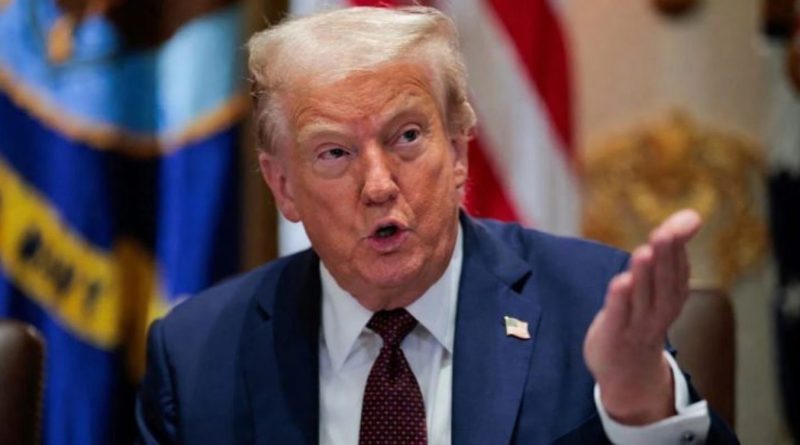
Trump Moving Forward With Defense Dept. Name Change
The Trump administration is reportedly considering plans to restore the Pentagon’s original name, the United States Department of War, according to reporting from The Wall Street Journal.
While such a change would likely require congressional approval, the White House is also exploring alternative pathways. Greg Steube (R-FL) has introduced an amendment to the annual defense policy bill proposing the name change, signaling some support within Congress.
A Pentagon spokesperson indicated that the title “Department of War” could better reflect the military’s offensive capabilities. White House spokeswoman Anna Kelly echoed that view, stating that President Donald Trump has emphasized focusing on “warfighters” and prioritizing offensive readiness. “As President Trump said, our military should be focused on offense — not just defense — which is why he has prioritized warfighters at the Pentagon instead of DEI and woke ideology. Stay tuned!” Kelly said.
Trump recently publicly floated the idea of renaming the United States Department of Defense back to the War Department. The agency was known as the War Department from the nation’s founding until the late 1940s, following World War II.
“It used to be called the Department of War and it had a stronger sound,” Trump said. “We want defense, but we want offense too … As Department of War we won everything, we won everything and I think we’re going to have to go back to that.”
When George Washington formed his first Cabinet, it included four departments: State under Thomas Jefferson, Treasury under Alexander Hamilton, the Attorney General’s office under Edmund Randolph, and the War Department led by Henry Knox.
The War Department remained in place until 1947, when it was reorganized into the Departments of the Army, Air Force, and Navy. The United States Department of the Navy, first established in 1798, had previously operated under the War Department’s authority.
After World War II, President Harry Truman pushed for a unified military structure. In July 1947, he signed the National Security Act of 1947, creating the National Military Establishment and establishing the National Security Council, the Joint Chiefs of Staff, and the United States Air Force.
All of these entities were placed under the National Military Establishment, with James Forrestal confirmed by the Senate as its first director. In 1949, the organization was officially renamed the Department of Defense.
Separately, leadership changes occurred at the Defense Intelligence Agency following the leak of a preliminary bomb-damage assessment related to U.S. strikes on Iran. Jeffrey Kruse, who had led the DIA since February 2024, was dismissed, according to defense officials.
Deputy Director Christine Bordine has been listed as acting director on the agency’s official website. Defense Secretary Pete Hegseth reportedly removed Kruse due to a “loss of confidence,” according to congressional officials cited by The New York Times.
The DIA’s classified assessment focused on U.S. strikes conducted on June 21 targeting Iran’s nuclear facilities at Fordow Fuel Enrichment Plant, Isfahan Nuclear Technology Center, and Natanz Nuclear Facility. The strikes reportedly involved Northrop B-2 Spirit bombers and cruise missiles.
According to reports, the leaked assessment suggested Iran could potentially restore parts of its nuclear program within one to two months and that its stockpile of enriched uranium had not been fully destroyed. The document was described as a “low confidence” evaluation based on limited intelligence gathered shortly after the strike.
The leak drew strong criticism from President Trump, who wrote on Truth Social that the report was “AN ATTEMPT TO DEMEAN ONE OF THE MOST SUCCESSFUL MILITARY STRIKES IN HISTORY,” adding, “THE NUCLEAR SITES IN IRAN ARE COMPLETELY DESTROYED!”
Meanwhile, special envoy Steve Witkoff rejected claims that the strikes failed to meet objectives, calling such suggestions “completely preposterous” during an interview on Fox News.